
American vs European Elderberries — What’s the Difference
If you have shopped for dried elderberries or read the back of a syrup label, you have run into two Latin names: Sambucus canadensis and Sambucus nigra. One gets called American elderberry, the other European elderberry or European black elder. Customers ask us regularly which one is better. The honest answer is that the question is less clear-cut than the labels make it look, and most of the differences that do exist matter more to the people growing the plant than to the person holding the bottle.
The line between them is blurrier than the labels suggest
Botanists have gone back and forth for years on whether these are two species or one species with regional variants. The Missouri Botanical Garden notes that American elder and European elder are closely related, and that some authorities treat the American plant as a subspecies or variety of Sambucus nigra rather than a species of its own.
You will see it written both ways in perfectly reputable places. Older references say Sambucus canadensis. Newer ones, including the U.S. Forest Service, use Sambucus nigra subspecies canadensis. Both names point at the same plant.
Two things follow from that. A product listing Sambucus nigra is not automatically European stock. And a product listing Sambucus canadensis is not a different berry in any dramatic sense. The Latin name tells you less than the sourcing does.
How the two plants differ in the field
The real differences show up in how the plants grow, which is why growers care about the distinction more than shoppers do.
- Habit. American elderberry is a fast, suckering, multi-stemmed shrub that spreads into colonies and is usually cut back hard to stay manageable. European elder builds a woodier frame over time and grows more like a small tree.
- Size. American elderberry typically reaches five to twelve feet tall with a similar spread, larger in rich, damp ground.
- Flowering and fruit. Both carry broad, flat-topped clusters of small white flowers that give way to purple-black fruit. American elderberry flowers later than most shrubs and ripens in late summer, which is what sets the harvest window across the Midwest.
- Where it turns up. American elderberry grows along streambanks, fence rows, woodland edges and roadsides throughout the eastern and central United States. European elder is native to Europe and grows here as an introduced plant.
Why the native range matters in Indiana
Purdue’s arboretum lists Sambucus canadensis as an Indiana native, and for a family farm operation in southern Indiana that is more than trivia. A plant that already belongs in the local soil and climate needs less coaxing to thrive, feeds the songbirds and pollinators that are already here, and fits a growing approach built on stewardship rather than inputs. It is a large part of why the American plant is the backbone of elderberry growing across this part of the country.
Does the species change what ends up in the bottle?
Less than the marketing around it suggests. What you actually taste in a finished syrup is driven by the cultivar, how ripe the fruit was when it was picked, how fast it went from harvest to processing, and what else goes into the pot alongside it. Elderberry of either type is tart, deep and faintly earthy as a raw material — nobody eats it for sweetness. That is why every syrup recipe carries honey, maple or another sweetener, and we go through those choices in our guide to elderberry syrup sweeteners.
Either one has to be cooked
This matters far more than the species question, and it is the part people skip. Raw elderberries, along with the stems, leaves and seeds, contain naturally occurring compounds that can release cyanide during digestion. University of Minnesota Extension is direct about it: raw or improperly prepared elderberries can cause nausea, vomiting and worse, and cooking is what makes prepared jams and syrups safe to enjoy.
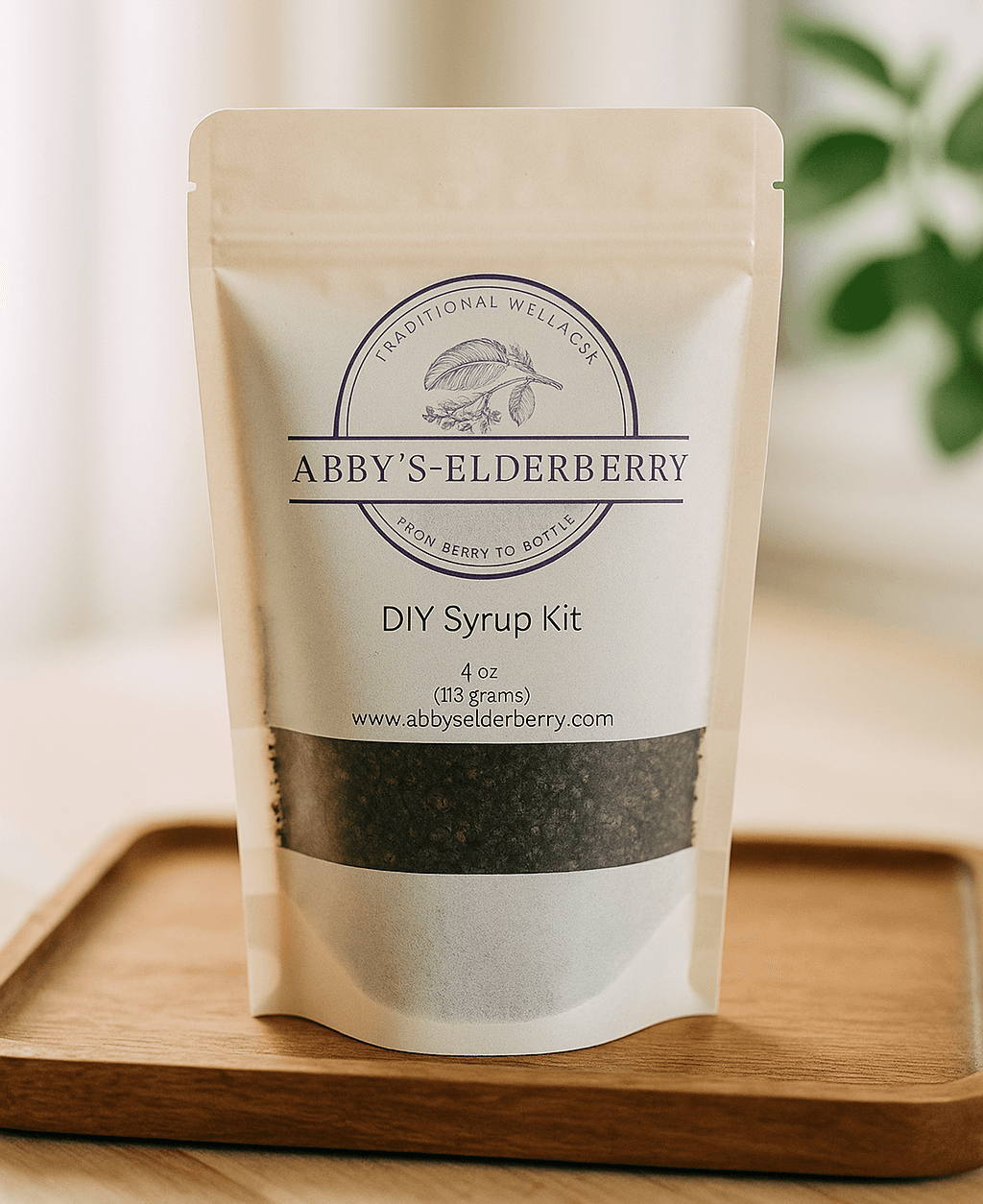
Dried berries are no exception. Drying preserves fruit, it does not heat-treat it, and dried elderberries still need to be cooked before anyone drinks what you make. If you are working from our dried organic elderberries or our DIY Elderberry Kit, simmer the berries properly and strain out stems and any underripe fruit before you press. That rule applies to canadensis and nigra alike.
What to look for when you buy dried elderberries
- Whether the berries are certified organic, and where they were actually grown.
- Whether stems and underripe fruit were sorted out before drying.
- Whether the instructions tell you to cook the berries. If they do not, that tells you something about the seller.
- Treat a Latin name on the label as botany, not country of origin.
What goes into ours
Every batch we make starts with certified organic elderberries and ingredients sourced from family farms we trust, and we are proud members of Indiana Grown. If you want to go deeper than a bottle or a blog post, The Elderberry Book by John Moody covers identification, cultivation and preparation in real depth, and it pairs naturally with dried berries and a kit.
The short version
American and European elderberries are close enough that botanists still argue about whether they are one plant or two. They grow differently, the American one belongs in this soil, and neither is safe raw. Past that, how a berry was grown, sorted and processed tells you far more about what is in a bottle than the Latin name on the label does. That is the standard we hold our own elderberry syrup to.
Get in Touch
Contact Number: 812-748-2111
Email: info@abbyselderberry.com
These statements have not been evaluated by the Food and Drug Administration. This product is not intended to diagnose, treat, cure, or prevent any disease.