Elderberry Syrup, Tea, or Tincture — Which One Suits Your House
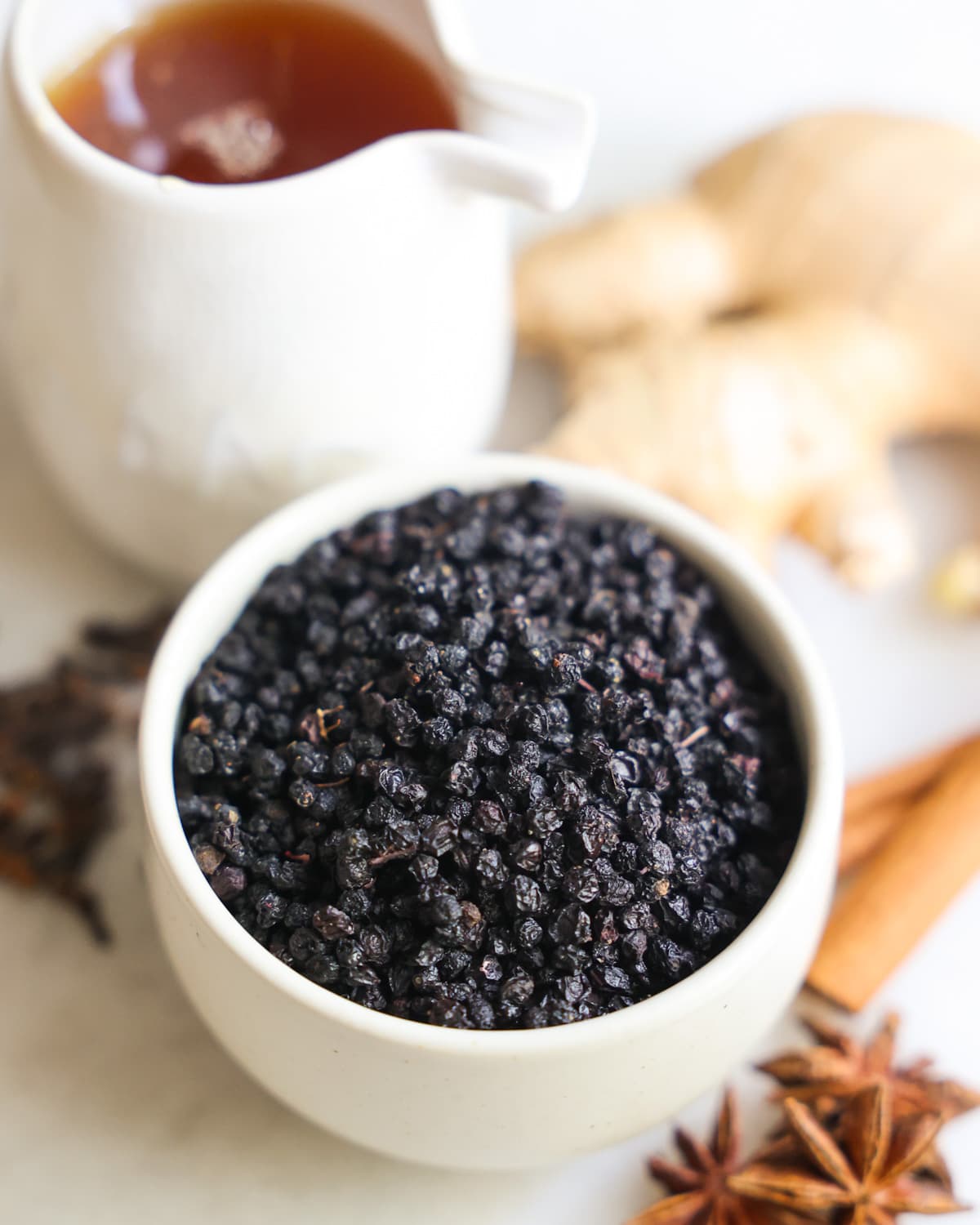
The same elderberry shows up in our shop three ways. A bottle of syrup, a pouch of loose tea, a small dropper bottle.
None of them is the serious one. They differ in how much effort they ask of you, where you can keep them, and whether they travel. Pick on that basis.
Syrup
Syrup asks nothing. Open the bottle, pour a spoonful, done. No kettle, no steeping.
It’s also the only one you can cook with. Our family stirs it into yogurt, pours it over pancakes, whisks it into salad dressing, and uses it as a glaze on meat. A bottle that gets used five ways gets finished.
The cost is fridge space. Most of our bottles are refrigerated and carry a real window rather than an open-ended date, though we make honey and maple in shelf-stable versions for houses where that doesn’t work. Every formulation is on the syrup pages.
Pick syrup if you’re feeding several people, or if you’d rather buy an ingredient than a supplement.
Herbal Tea
Tea asks for ten minutes. Boil, measure, steep, sit down. For the people who choose it, the pause is most of the point.
It also gives you range that syrup can’t. Chamomile and lemon balm for the evening. Hibiscus for something tart and ruby-red. Ginger for warmth. One blend is built on an Indiana Assam black tea base, so that one carries caffeine while the herbal blends don’t — worth knowing after four o’clock. The full range is under herbal teas.
A sealed pouch keeps in a cupboard and takes no fridge space at all.
Pick tea if you want the ritual, or variety across the week rather than the same spoonful every morning.
Tinctures
A tincture is a concentrated herbal extract in a small dropper bottle. It fits in a handbag, a glove box, or a desk drawer, and needs neither a kettle nor a fridge.
Ours are single-herb extracts in two-ounce bottles, which is the real difference: you choose one botanical rather than a blend someone else composed. See what we currently stock under tinctures. If you’re new to extracts, the National Center for Complementary and Integrative Health keeps plain-language pages on individual herbs.
Pick a tincture if you travel, or if you already know which single herb you want on hand.
Side by Side
- Effort — syrup none, tea a few minutes, tincture none.
- Storage — most syrup needs the fridge; tea and tinctures keep in a cupboard.
- Cooking — only syrup.
- Travel — dropper bottle first, tea second, glass syrup bottle last.
- Household — syrup suits several people; tea and tinctures suit one person’s routine.
Most Houses End Up With Two
Syrup in the fridge for the family, tea in the cupboard for the evening. Syrup at home, a tincture in the bag. They were never really competing.
Our Bundle Builder lets you mix syrups, teas, tinctures, and pantry goods into one order and save against buying each piece separately. It’s the cheapest way to find out which format your house actually reaches for.
Same Berry Underneath
Whichever you choose, the elderberry is the same. Certified organic under the USDA National Organic Program, made in small batches here in southern Indiana as an Indiana Grown member family.
One thing holds across all three, and across anything you make yourself: elderberries are always cooked before they’re used. Raw berries, stems, and leaves don’t agree with people, which is why every traditional preparation involves heat. Britannica’s entry on the elder covers the plant’s long history if you want the background.
Get in Touch
Contact Number: 812-748-2111
Email: info@abbyselderberry.com
These statements have not been evaluated by the Food and Drug Administration. This product is not intended to diagnose, treat, cure, or prevent any disease.